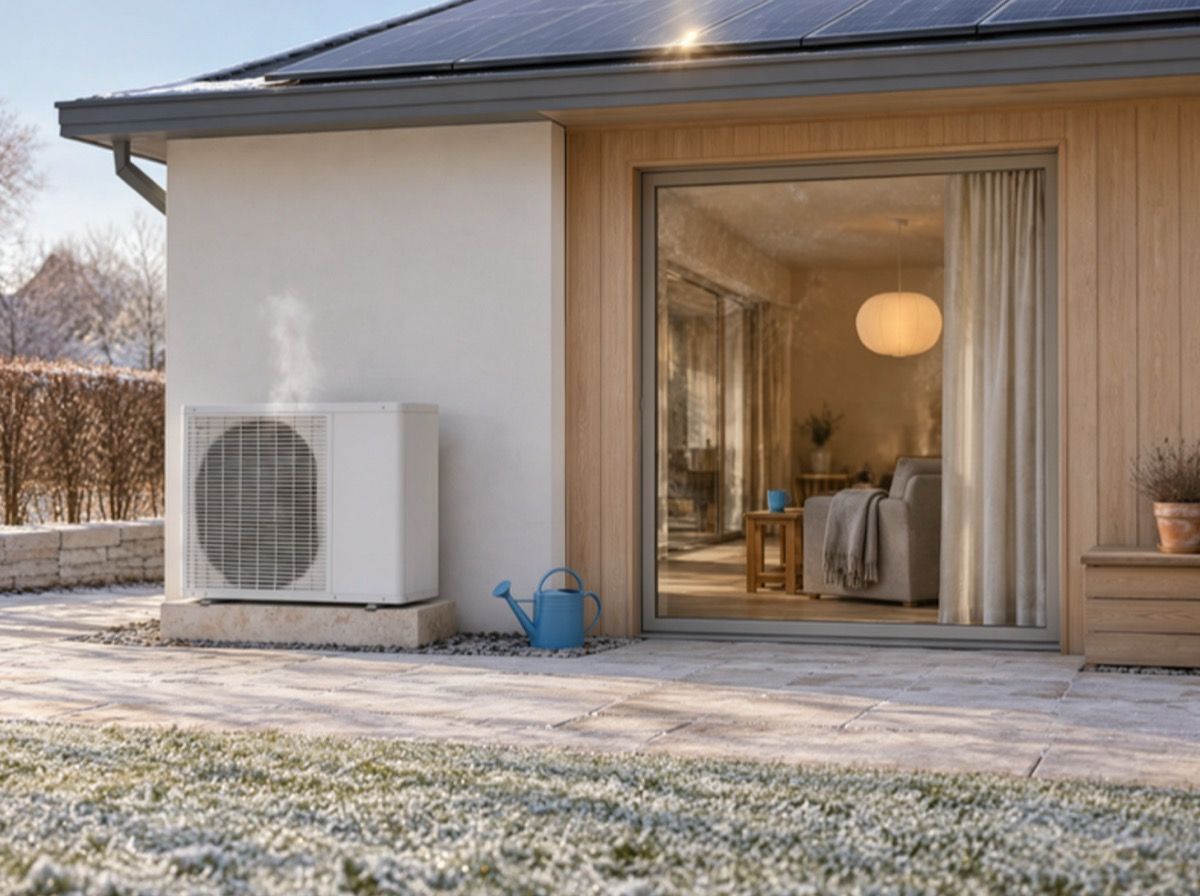
If the price of your electricity changes during the day, or there are solar panels on your roof, it makes a big difference when the heat pump runs. SG-Ready is a simple signal that most heat pumps today understand, and all three myIO controllers can send it: the V3, the V4 GIGA and the V4 Opta. No extra device is needed, just two wires and a few minutes of setup.
What is SG-Ready?
SG-Ready (Smart Grid Ready) is a common signal of heat pump manufacturers. The heat pump has two control inputs, and their state means one of four operating modes:
Pause
The heat pump waits, for example during the expensive peak. Its frost protection keeps working.
Normal
The machine runs its own programme, as if we were not there.
Recommended
Electricity is favourable now: the machine heats ahead with a higher target temperature and stores the heat.
Forced run
A firm start, for example with a large solar surplus, within the machine’s own protection limits.
So the heat pump is not told how to heat: its own control still decides that. SG-Ready only signals that electricity is favourable or unfavourable right now. That is why it is safe: frost protection and compressor protection always work. What exactly the machine does in the recommended and forced modes depends on the manufacturer; you will find it in the heat pump’s manual.
Why is it worth it?
- It heats in the cheaper hours. If your electricity price changes during the day, for example with off-peak electricity or a contract tied to the spot price, part of the heating can be moved to the cheap hours. How much this saves depends on the house, the heat pump and the tariff.
- Your solar power is worth more. If you have solar panels, you can set the recommended mode for the sunny hours: the heat pump heats ahead when it can run on your own electricity, instead of you feeding it back to the grid for little.
- You are ready for change. If one day your feed-in is no longer net metered, or you switch to a time-of-use tariff, you only have to change the schedule.
- No loss of comfort. The system does not switch the heating off, it reschedules it. The difference is smoothed out by the heat stored in the house: the underfloor heating, the buffer tank or the hot water tank.
How does myIO do it?
- No extra device. The electrician connects two outputs of myIO to the SG input of the heat pump. No voltage goes onto it: the output only closes or opens, like a switch.
- Its own page in the web interface. The four modes can also be switched by hand with one click.
- With the timer. With the usual weekly timer you set which mode applies at which time of day: for example pause during the expensive peak, and the recommended mode in the cheap hours.
- Built-in limits. By default, the pause lasts at most two hours, then myIO returns to normal on its own, so a wrong setting cannot let the house cool down. After a restart it also starts in normal mode, and no other control can change the chosen pair of outputs.
Which heat pumps can do it?
Most heat pumps today. Look for the “SG-Ready” label or a “Smart Grid” input in the manufacturer’s documentation. It works the same way with any other device that has an SG-Ready input, for example a hot water heat pump. If you are not sure, send the model to info at myio dot hu, and we will check.
Frequently asked questions
Doesn't all the switching harm the machine?
No. The SG-Ready signal does not switch the compressor on and off; it only suggests an operating mode, which the machine carries out on its own schedule. Its frost and machine protection keep working during a pause too.
Do I need solar panels?
No. It pays off without solar panels too, if your electricity price changes during the day. With solar panels you make better use of your own electricity.
Can I add it to an existing myIO?
Yes. The V3, the V4 GIGA and the V4 Opta can all do it; if your software is older, an update brings it. You need two free outputs and two wires to the heat pump.
How much can I save with it?
That depends on the house, the heat pump and the electricity tariff, so we do not promise a number. The bigger the difference between the cheap and the expensive hours, and the better the house stores heat, the more it brings.
For professionals
- SG pair: any two outputs (relay or output), connected as potential-free contacts to the SG input of the heat pump, without applying voltage.
- Modes (K1:K2): 1 = 1:0 lockout (utility lock, time-limited, 120 minutes by default), 2 = 0:0 normal, 3 = 0:1 recommended, 4 = 1:1 forced.
- Switching with the weekly timer or by hand, on the Smart Grid page of the web interface. The pair is locked: the controller restores the correct state every minute, so it must not be part of a lockout or coupler pair.
- After a restart the lockout is not restored, the controller starts in normal mode; the recommended and forced modes are restored.
- V3, V4 GIGA and V4 Opta. The exact behaviour of the recommended and forced modes depends on the manufacturer.