myIO DewPoint
For ceiling and wall cooling: myIO DewPoint senses the risk of condensation right at the cooled surface and acts before it happens. It also works on its own, without a myIO Server.
You get an itemized price in the Studio, calculated for your own home.
Who is it for?
- You are building ceiling or wall cooling and do not want moisture to condense on the cold surface.
- It suits any heating and cooling system: it works on its own, without a controller, phone, internet or subscription.
- You have, or will have, a myIO system: it connects to myIO Server V3 and V4 GIGA over a serial line.
What you get
Measures where the risk is
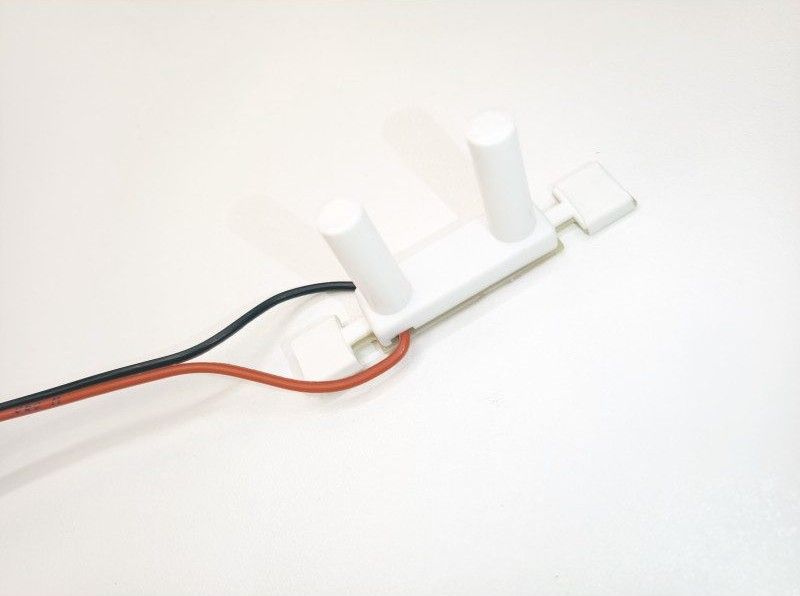
The sensor sits right on the cooling pipe, in the plaster. It does not calculate, it measures: it reacts at once to the humidity of the air next to the surface.
Mixes warmer water
The built-in 0–10 V output controls the mixing valve: the closer the surface gets to the dew point, the warmer the water it mixes, so condensation never happens.
Blocks when needed
One relay per zone blocks the cooling circuit, and a shared safety relay can also stop the pump or the main line.
Three zones on one module
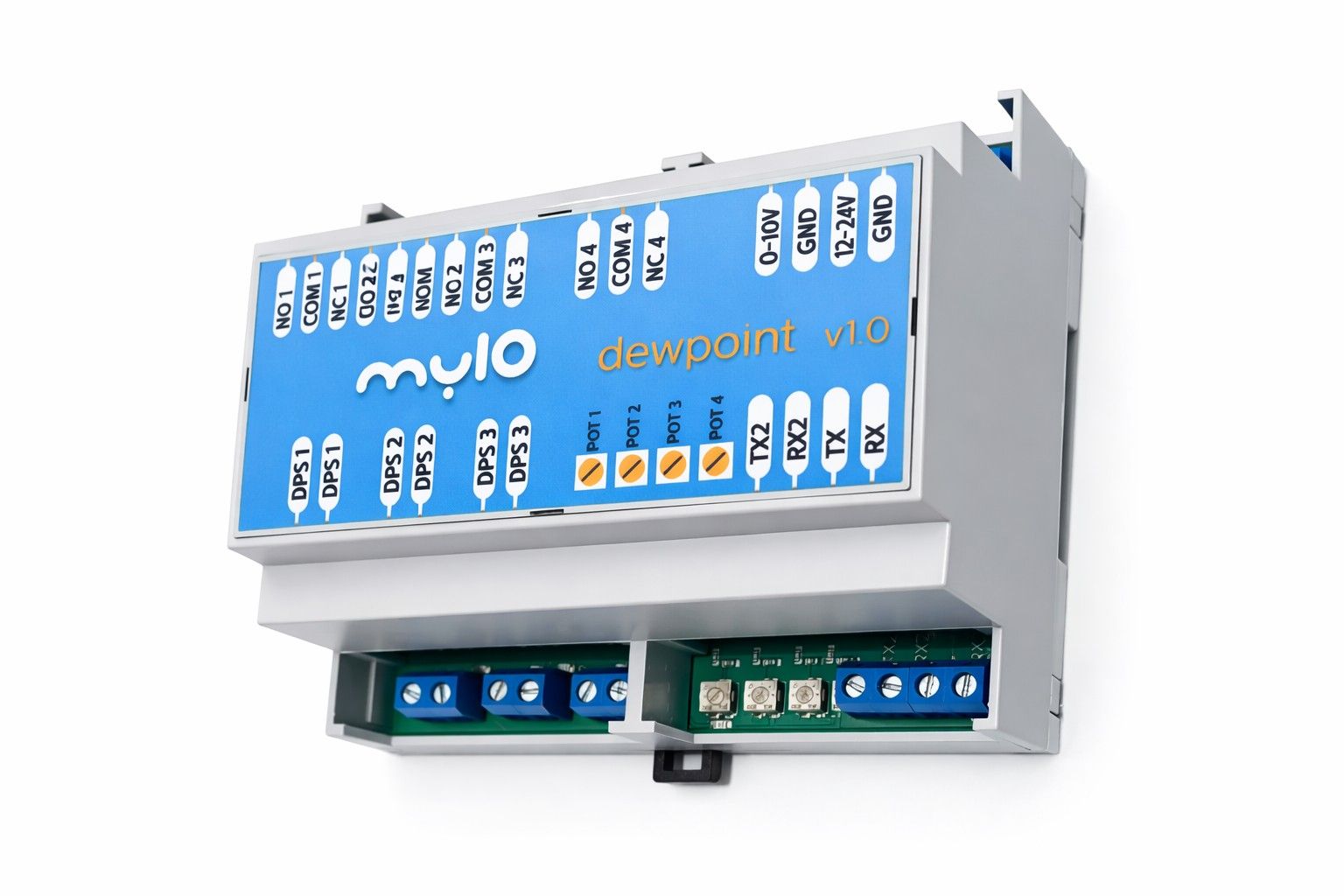
3 sensor inputs per module, one per zone, with up to 3 sensors on each input. In larger systems several modules connect over a serial line.
Set with a screwdriver
Four potentiometers set it up. No software, display or complicated settings needed.
Works on its own
No controller, computer, phone, internet or subscription needed. With a myIO Server V3 or V4 GIGA, the protection can be linked into the system too.
- 2-year warranty
- 12–24 V power supply
How does it work?
The sensor goes on the pipe
Before plastering, clamp the sensor onto the cooling pipe. After plastering and painting, cut the air inlet tubes flush, so the room air reaches the sensor.
The module watches
DewPoint continuously watches all three sensors, each one separately.
The dew point gets closer
The 0–10 V output mixes warmer water at the mixing valve, so the surface stays above the dew point.
It blocks in case of danger
The zone relay blocks the cooling circuit, and the shared safety relay can also stop the pump or the main line.
Why is it better than a wall thermostat?
A wall thermostat measures temperature and humidity at a single point in the room and calculates the dew point from them. That remains a theoretical value and ignores local conditions.
With ceiling cooling, the most critical point is always around the cooled surface, where the air can be much colder and more humid than in the rest of the room. The myIO DewPoint sensor measures exactly there, and senses the dew point through the real physical effect rather than a calculation. That makes it faster, more precise and more reliable.

For professionals
More details
- Sensor inputs
- 3 inputs, one per zone; in group mode up to 3 sensors in parallel per input, at most 9 in total
- Outputs
- 4 relays (3 zones + 1 shared safety relay), 1 × 0–10 V for the mixing valve (driven by the most humid point)
- Setup
- 4 potentiometers: minimum, maximum, measuring interval, threshold
- Measuring principle
- The electrical resistance of the air next to the surface, which reacts directly to rising humidity
- Connection
- Serial line: several modules can be chained, and it connects to myIO Server V3 and V4 GIGA. It cannot be used with the V4 Opta.
- Power supply
- 12–24 V
- Mounting
- DIN rail, D6 size enclosure
- Sensor
- Clamps onto the pipe and goes under the plaster, with a 10 m cable; air inlet tubes flush with the plaster
- Warranty
- 2 years
- Hardware
- STM32 (myIO DewPoint firmware)